
Making more plant-based stuff available doesn't change much
We tried it in a Chipotle-like setting and found changes of ~ 1-2 pp.

(I co-authored this with Jessica Hope, Jacob Peacock, and Maya Mathur and it’s re-posted basically verbatim from the EA forum.)
This post summarizes a new preprint from the Humane and Sustainable Food Lab at Stanford titled “Taking a bite out of meat, or just giving fresh veggies the boot? Plant-based meats did not reduce meat purchasing in a randomized controlled menu intervention.”
The paper reports on an online RCT where participants were asked to select taco fillings from one of three menus designed to mimic the options at Chipotle. They could choose from both meat- and plant-based options.
The randomized treatment was whether participants saw
one plant-based option (veggie & guacamole)
two (veggie + ‘Sofritas,’ an existing plant-based meat analogue (PMA) that you can get at Chipotle)
or three (veggie + Sofritas + ‘Chick’nitas,’ a hypothetical chicken-analogue PMA).
The treatment was embedded in a series of decoy questions about choosing pens and t-shirts to obscure the purpose of the study.
The main outcome was whether people chose a meat-based taco filling or not. Our second outcome was whether Chick’nitas reduced demand for chicken specifically among meat-based options. All outcomes were hypothetical, and price was held constant.
We powered the study to detect a 5 percentage point (pp.) reduction in meat selection, the smallest effect size which we thought might prompt Chipotle or someplace similar to consider adding a new PMA.
Unfortunately, we didn’t find an effect of that magnitude.
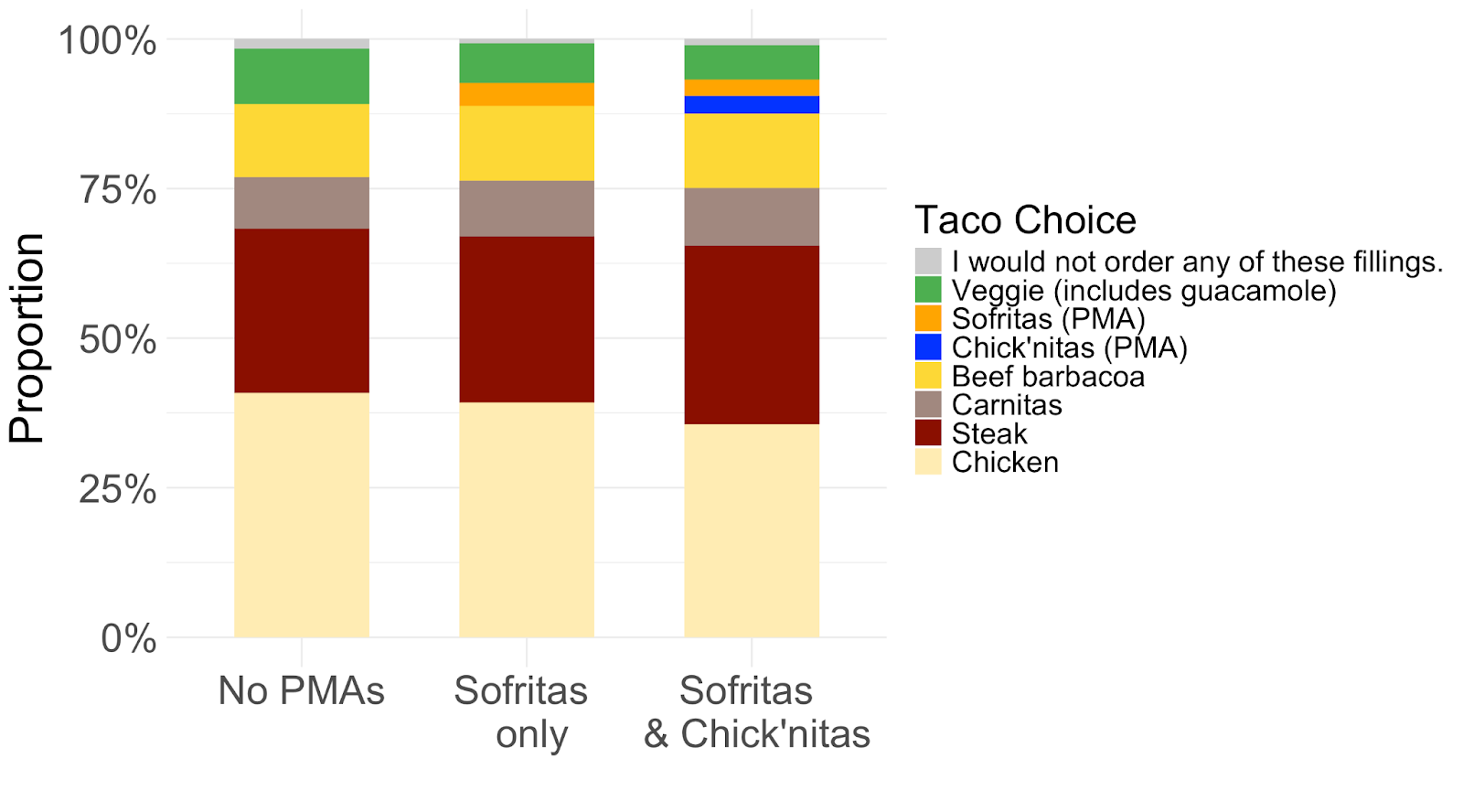
Compared to having just veggies::
adding Sofritas reduced demand for meat by 1.14 pp. (95% CI [-3.30, 1.02], p = .30).
adding Sofritas and Chick’nitas reduced demand for meat by 2.14 pp (95% CI [-4.36, 0.08], p = .06).1
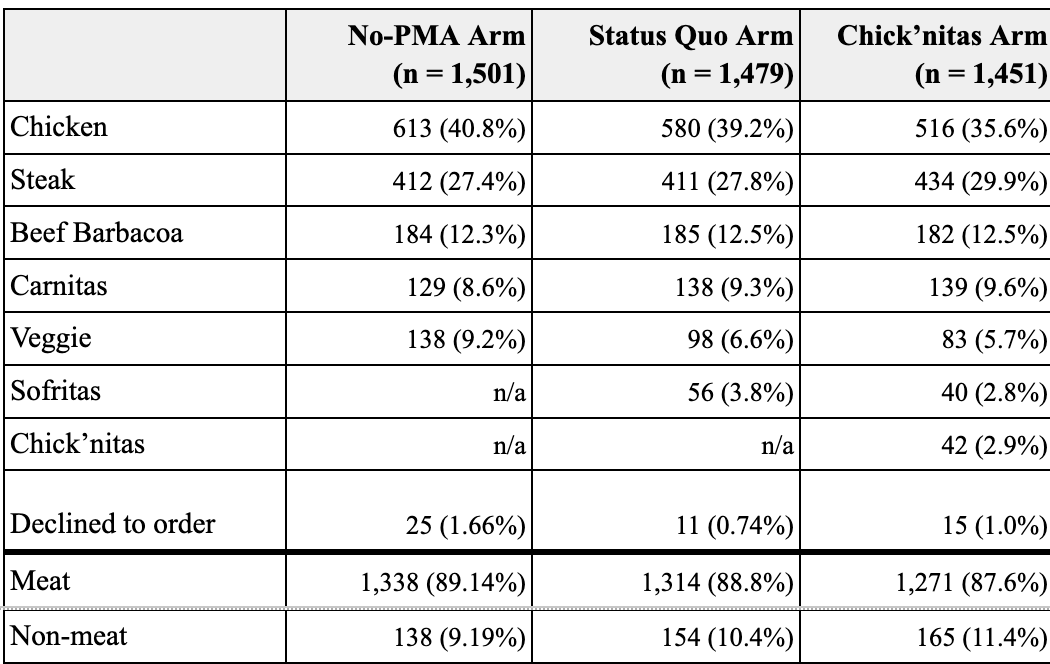
Adding Chick’nitas modestly but insignificantly decreased demand for chicken, but simultaneously, demand for steak increased. Going from no PMAs to two decreased demand for veggie & guac from 9.2% to 5.7%.
See table below for full breakdown.
Men, Republicans, people without a four-year college degree, and people who ate more than ten or more servings of meat per week were all more likely to select a meat-based taco filling than folks in other categories.
We don’t know if we’d have found bigger effects if we’d run the experiment in stores. Our experiment didn’t include any sensory information, so perhaps the Chick’nitas would have been more appealing in person, or perhaps less.
Key takeaways
Just making an additional plant-based option available did not meaningfully change reported consumption patterns. This held for both a long-standing PMA option (Sofritas) and a novel one (Chick’nitas). Reducing meat consumption is a hard problem, and achieving price-, taste-, and convenience- parity won’t obviously do the trick either.
Technology will likely play a large role if we are to transition away from factory farming, as it has for past externalities; but we also see an important role for culture and attitudinal change, as well as changing the choice architecture of meal environments and actively promoting plant-based options.
I was thinking of these results when I wrote “Expect 1-2 pp. changes and you won't be disappointed.”
Findings like these definitely make me worried. But I also don’t want to read too much into them because I think there’s a pretty big issue: alternative meats don’t yet taste as good as animal-derived meats, but they might in the future. If instead of sofritas (marinated tofu that tastes like marinated tofu) we had lab-grown pork (which, presumably, could be made to taste exactly like traditional carnitas), I’d be much more surprised if few people made the switch. (And I realize people express hesitancy about trying this sort of thing in surveys, but am not convinced that this would stick around in a world where these options actually existed, especially given the accompanying cultural shifts I would expect)